7 Raw Feeding Mistakes Dog Owners Make
The most common raw feeding errors are wrong ratios, overfeeding liver, and no protein rotation. Here is how to spot and fix each one.
Why Mistakes Matter in Raw Feeding
Raw feeding done correctly is one of the best things you can do for a dog's long-term health. Raw feeding done carelessly creates subtle deficiencies that can take months to show up, by which time you've got a dog with a dull coat, weak immune function, or bone density problems.
None of these mistakes are hard to fix once you know about them. Most come from simplifying the diet in ways that feel reasonable but create nutritional gaps.
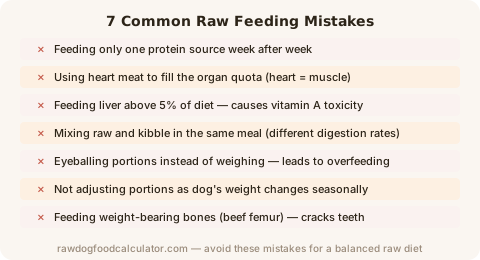
Mistake 1: Feeding One Protein Source for Months
Chicken is cheap, universally available, and most dogs love it. So many raw feeders end up with a diet that's 95% chicken, and this is a problem.
Different proteins carry different micronutrient profiles. Chicken is low in zinc and omega-3 fatty acids compared to beef. Beef is low in iodine. Lamb is high in selenium. Fish provides DHA and EPA at levels no land animal can match. No single protein covers everything.
The fix: Rotate through at least 3 protein sources per week. A simple rotation: chicken twice, beef twice, turkey or lamb twice, fish once. This also ensures your dog won't become fixated on a single protein and refuse variety when it becomes necessary (allergies, supply issues, cost changes).
Mistake 2: Using Heart to Fill the Organ Quota
Heart is one of the most valuable foods in a raw diet. It's packed with CoQ10, taurine, B vitamins, and iron. But it is muscle tissue, not secreting organ.
The distinction matters because secreting organs (liver, kidney, spleen, pancreas) provide a completely different set of nutrients than muscle. Heart does not satisfy the 5% other organ requirement. A diet of 75% muscle + 5% heart + 10% bone + 5% liver + 5% vegetables is missing the second organ layer entirely.
The fix: Keep heart in the muscle meat category. Source actual secreting organs (kidney, spleen, pancreas) for the second 5% of your organ allocation.
Mistake 3: Overfeeding Liver
More is better with most foods. Not with liver. Liver is extraordinary, but at 5% of the diet, the vitamin A it provides is already toward the upper end of what dogs need daily. Feed 10% liver and you've doubled that.
Hypervitaminosis A in dogs is a real, documented condition. Early signs include reduced appetite and lethargy. Chronic overexposure causes calcification of soft tissue, joint pain, and eventually liver damage. This develops slowly, which is why some raw feeders don't notice the connection until the dog is quite ill.
The fix: Weigh liver. 5% of total daily food, hard cap. A 65 lb dog eating 26 oz/day needs exactly 1.3 oz of liver per day. Not 2 oz. Not 3 oz. Use our raw food calculator to see exactly how many ounces your dog's 5% liver allocation works out to.
Mistake 4: Mixing Raw and Kibble in the Same Meal
This is the most common beginner mistake, thinking a "blend" is a gentle transition. In reality, kibble and raw have very different gastric emptying times. Raw meat clears the stomach in 3-4 hours; kibble takes 8-12 hours. Feeding them together can cause the meat to sit in a fermenting kibble environment, leading to nausea and vomiting.
The fix: Hard switch, or feed kibble and raw in completely separate meals with several hours between them. Most dogs handle the hard switch fine with a 12-24 hour fast preceding the first raw meal. For the full transition protocol, read our raw diet transition guide.
Mistake 5: Eyeballing Portions
"Looks about right" is fine for experienced raw feeders who've been weighing for years and can now estimate visually. It's a problem for everyone else.
A cup of chicken thigh meat and a cup of beef liver weigh completely different amounts. The density of muscle meat varies by fat content, water content, and cut. Without a scale, you'll chronically overfeed or underfeed components, often both simultaneously (too much of the cheap stuff, not enough of the expensive stuff).
The fix: Buy a digital kitchen scale (under $15) and weigh every component for at least the first 3-4 months. Once you've calibrated your eye, you can reduce to occasional spot-checking. Never eyeball organ meat, it's too easy to overfeed liver significantly.
Mistake 6: Not Adjusting Portions for Weight Changes
You calculate your dog's portions at 65 lbs and feed that amount for the next two years. Meanwhile your dog has drifted to 72 lbs (gaining), or 58 lbs (losing after an illness), and you're still feeding the 65 lb amount.
Percentage-based feeding means the absolute amount must change when weight changes. 2.5% of 65 lbs ≠ 2.5% of 72 lbs, there's a 2.8 oz per day difference, which adds up to nearly 1 lb of extra food per week.
The fix: Weigh your dog monthly. Update their daily food calculation when weight changes by more than 3-4 lbs. Use our raw dog food calculator, input the new weight and it recalculates everything instantly.
Dogs also have seasonal weight fluctuations (some dogs carry more body weight in winter), activity changes (summers can be more active; winter often less), and age-related metabolic shifts. All of these warrant portion adjustments.
Mistake 7: Feeding Weight-Bearing Bones
Beef femurs, knucklebones, marrow bones, these are sold in pet stores, recommended by well-meaning people, and genuinely dangerous for most dogs' teeth.
Weight-bearing bones are the densest bones in an animal's skeleton. They evolved to support hundreds of pounds of body weight, they're hard enough to crack a dog's tooth, including large breeds. Slab fractures of carnassial teeth (the large shearing teeth) are one of the most common dental injuries vets see in raw-fed dogs, and weight-bearing bones are frequently the culprit.
The fix: Feed only consumable raw meaty bones, chicken backs, turkey necks, duck necks, lamb ribs, rabbit pieces. If you want to give a beef bone, choose rib sections (not weight-bearing), never femurs. See our raw meaty bones guide for a complete size-appropriate bone list.
A Quick Self-Audit
If you're raw feeding already, run this check:
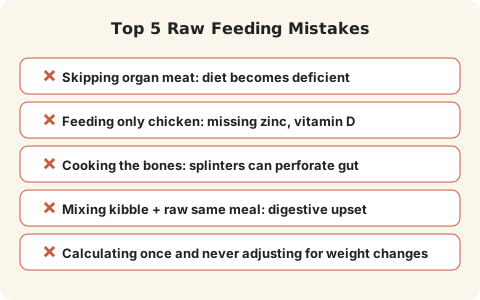
- Are you using 3+ proteins per week? If not, add variety.
- Is heart in your muscle column, not your organ column?
- Have you weighed your dog in the last month? Is the food amount current?
- Is liver measured, not guessed?
For a full breakdown of correct ratios and daily amounts, use our raw dog food calculator and compare the output to what you're currently feeding. Gaps are usually fixable in a single shopping trip.