Raw Feeding Puppies: A Complete Getting-Started Guide
Puppies need 5-8% of their body weight in raw food daily. This guide covers exact portions, meal frequency, bone safety, and what to watch for.
Why Puppies Need More Than Adults
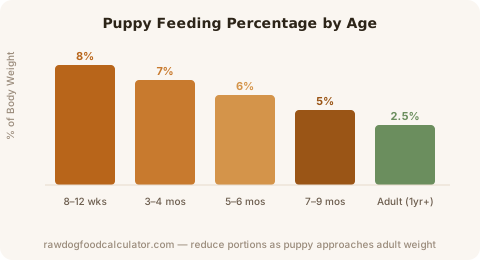
A puppy's body is doing something extraordinary, doubling, tripling, sometimes quadrupling its weight in the first year of life. Bone density is building, organ systems are maturing, and a growing brain is demanding constant fuel. This is why puppies eat 5-8% of their body weight per day when adult dogs eat just 2-3%.
Get this wrong in either direction and there are consequences. Underfeed a growing puppy and you risk stunted growth, poor bone density, and immune deficiency. Overfeed, especially with too much calcium, and you can cause developmental orthopedic disease, a condition seen in large and giant breeds where bone growth outpaces skeletal maturation.
Raw feeding puppies is genuinely doable, but it rewards attention to detail.
Feeding Percentages by Age
| Age | Daily % of Body Weight |
|---|---|
| 8-12 weeks | 8-10% |
| 3-4 months | 7-8% |
| 5-6 months | 6-7% |
| 7-9 months | 5-6% |
| 10-12 months | 4-5% |
| Adult (12+ months) | 2-3% |
Weigh your puppy every week for the first 6 months, their weight changes fast, and so should their food amount. A 10 lb puppy at 10 weeks might be 25 lbs by 16 weeks. If you're still feeding 10% of 10 lbs (1.6 oz), they're getting less than half what they need.
Use our raw dog food portion calculator and select "Puppy", it calculates the right percentage based on life stage and adjusts for activity level.
Meal Frequency
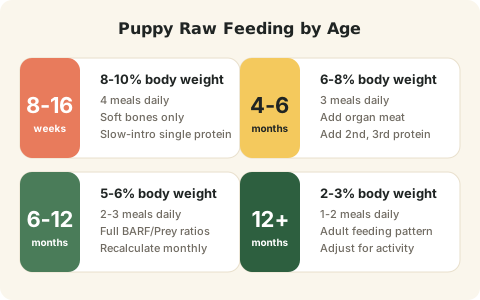
- Under 12 weeks: 4 meals per day
- 3-6 months: 3 meals per day
- 6-12 months: 2-3 meals per day
- Over 12 months: 2 meals per day
Puppies have small stomachs and fast metabolisms. Spreading meals keeps blood glucose stable, reduces the risk of vomiting from gorging, and makes calcium absorption more consistent. As their stomach capacity grows, you can consolidate to two meals.
Starting a Puppy on Raw
The safest starting point is a single protein source, chicken is ideal because it's mild, widely available, and easy to digest. Start with chicken backs or chicken necks for bone and chicken breast or thigh for muscle meat.
Week 1: Chicken only. Bone content should be around 10% (so a chicken back or quarter works). Feed four small meals per day. Expect some digestive adjustment, soft stools in week one are normal.
Week 2: Add a second protein (turkey or beef). Watch stool consistency before adding more variety.
Week 3+: Begin introducing organ meat, start with beef or chicken liver at 3-4% (slightly under the 5% target to allow gut adjustment). Add the remaining 1-2% from kidney or spleen by week 4.
If you're on BARF, hold off on vegetables until the meat-bone-organ foundation is solid (usually 3-4 weeks in). Then add small amounts of pureed leafy greens.
Bone Safety for Puppies
Puppies can eat raw bones, in fact, they should for dental and jaw development. But size and density matter.
Safe puppy bones:
- Chicken wings, necks, feet, soft, fully consumable
- Duck necks, excellent for medium-sized puppies
- Turkey necks, better for larger breeds (Labs, Golden Retrievers)
- Rabbit pieces, often a puppy favorite; fully edible
Avoid for puppies:
- Weight-bearing bones from large animals (beef femur, marrow bones), too hard for puppy teeth
- Cooked bones of any kind, they splinter and can perforate the intestine
- Very large RMBs before the puppy has jaw strength to manage them
Always supervise bone meals, especially for puppies. A 12-week-old Lab mix eating a chicken wing for the first time needs you nearby, not because it's inherently dangerous, but because puppies learn by doing and need to develop the chewing technique.
Calcium and Phosphorus: The Critical Balance
This is where puppy raw feeding requires the most care, especially in large and giant breeds. Excessive calcium intake during growth has been directly linked to developmental orthopedic disease (DOD), a category that includes osteochondrosis, hip dysplasia (exacerbated by rapid growth), and panosteitis.
The National Research Council recommends a calcium-to-phosphorus ratio of 1.2:1 for growing dogs. Raw meaty bones naturally deliver calcium and phosphorus in roughly the right ratio, which is why the 10% bone guideline works. Problems arise when people add extra calcium supplements on top of an already bone-balanced diet.
If you're following the standard BARF or Prey Model ratios and rotating protein sources, you likely don't need extra calcium. If you're feeding boneless meat or ground meat only, you do, and this needs careful calculation or consultation with a veterinary nutritionist.
Example Calculation: 12-Week-Old Golden Retriever (12 lbs)
Using our raw dog food calculator, selecting Puppy + Moderate activity + BARF:
- Total daily food: ~15.4 oz (feeding at 8% of body weight)
- Muscle meat: 10.8 oz
- Raw meaty bones: 1.5 oz
- Liver: 0.8 oz
- Other organ: 0.8 oz
- Vegetables: 1.5 oz
Split across 4 meals: ~3.8 oz per meal. That's roughly a small chicken wing piece and a chunk of thigh meat per serving.
By 6 months this same dog might weigh 45 lbs, needing 40+ oz per day. This is why weekly weighing and monthly recalculation is standard practice among experienced raw-feeding breeders.
When to Consult a Vet
Raw feeding puppies is appropriate for most breeds in most situations, but loop in your vet or a board-certified veterinary nutritionist (DACVN) if:
- You're feeding a large or giant breed (Great Dane, Rottweiler, Mastiff), orthopedic risk is higher
- Your puppy has persistent diarrhea beyond the first two weeks
- Growth seems stunted compared to breed standard charts
- You want to run bloodwork to confirm micronutrient levels
For more on adapting raw feeding to older dogs, see our guide on raw feeding for senior dogs.