How Much Does Raw Dog Food Cost Per Month?
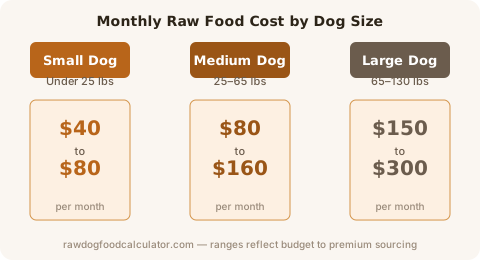
Raw feeding a small dog costs $40-80/month, a medium dog $80-160, a large dog $150-300. Here is the full cost breakdown and how to save money.
What Goes Into the Cost
Raw dog food cost breaks down across four components that you'll buy with very different price points:
1. Muscle meat (70% of the diet), This is the biggest cost driver. Chicken is the cheapest at $1.50-3.00/lb for thighs and backs. Beef runs $3-6/lb. Novel proteins like kangaroo, venison, or duck hit $6-12/lb. Most raw feeders use chicken as the base (60%+ of muscle meat) and add variety with other proteins a few times a week.
2. Raw meaty bones (10%), Often the cheapest component per pound. Chicken backs and frames go for $0.50-1.50/lb from butchers or Asian grocery stores. Turkey necks are $1-2/lb. If you're buying whole chickens and cutting them yourself, bones come with the purchase.
3. Organ meat (10%), Beef and chicken liver is cheap at $1-3/lb from most grocery stores. The challenge is the other 5%, kidney, spleen, and pancreas are harder to find but often near-free from a local butcher. Some raw pet food suppliers sell organ mix packs for $2-4/lb.
4. Vegetables (10%, BARF only), Minimal cost. A head of broccoli, a bag of spinach, some blueberries. This component costs $5-15/month even for large dogs.
Cost Per Day by Dog Size
Based on a mixed protein rotation (60% chicken, 25% beef, 15% other) at average supermarket and butcher prices:
| Dog Size | Daily Food | Avg $/lb | Daily Cost | Monthly Cost |
|---|---|---|---|---|
| 10 lbs (Chihuahua) | 4 oz (0.25 lbs) | $2.50 | $0.63 | $19 |
| 25 lbs (Beagle) | 10 oz (0.63 lbs) | $2.50 | $1.56 | $47 |
| 50 lbs (Lab mix) | 20 oz (1.25 lbs) | $2.50 | $3.13 | $94 |
| 65 lbs (Lab) | 26 oz (1.63 lbs) | $2.50 | $4.06 | $122 |
| 80 lbs (GSD) | 32 oz (2.0 lbs) | $2.50 | $5.00 | $150 |
| 100 lbs (Rottweiler) | 40 oz (2.5 lbs) | $2.50 | $6.25 | $188 |
These are mid-range estimates using mostly chicken with some beef. If you source entirely from premium grass-fed suppliers, multiply by 2-3x. If you use a local butcher or farm-direct sourcing, you can often beat these numbers.
To find your dog's exact daily food amount, use our raw dog food portion calculator, enter weight, life stage, and activity level.
Home-Prepared vs Commercial Raw
Pre-made commercial raw diets (brands like Primal, Stella & Chewy's, Darwin's, or Big Country Raw) are convenient but significantly more expensive.
| Source | Typical Cost Per Pound |
|---|---|
| Grocery store chicken | $1.50-2.50 |
| Butcher/farm direct | $1.00-2.00 |
| Pet store raw mix | $4-8 |
| Pre-made commercial raw | $6-12 |
| Freeze-dried raw | $15-25 |
For a 65 lb dog eating 1.63 lbs/day:
- Home-prepared at $2.50/lb: $4.06/day → $122/month
- Commercial pre-made at $8/lb: $13/day → $390/month
- Freeze-dried at $20/lb: $32.60/day → $978/month
Many raw feeders use a hybrid, home-prepared for muscle meat and bones, with pre-made organ mixes for convenience.
How to Reduce the Cost
Source Directly From Butchers and Farms
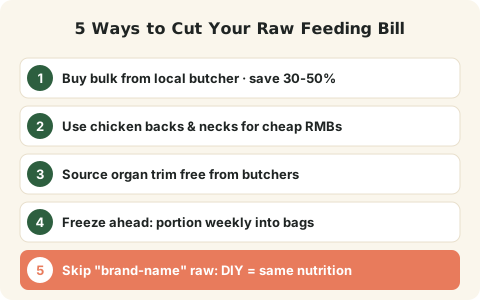
A good relationship with a local butcher is worth its weight in gold. Many butchers sell trim, organ meat, and bones at near-cost or free because they'd otherwise discard it. Show up, explain you're raw-feeding your dog, and ask what they have available. Chicken backs, beef trim, liver, and bones that aren't marketable to restaurant customers often sell for $0.50-1.00/lb.
Buy in Bulk and Freeze
Buying a week or two weeks' supply at once reduces price-per-pound significantly and saves multiple shopping trips. A chest freezer ($150-250 new, less used) pays for itself in 6-12 months through bulk savings.
Use Asian Grocery Stores
In most cities, Asian grocery stores carry chicken feet, duck necks, pork liver, and beef offal at a fraction of supermarket prices. Chicken feet (excellent RMBs and rich in joint-healthy collagen) often sell for $0.60-1.00/lb.
Grow Your Network
Raw feeding Facebook groups, subreddits like r/rawpetfood, and local co-ops often coordinate bulk buys from wholesalers at 30-50% below retail prices. A co-op order of a 40 lb box of mixed organ meat split between 6 households costs each person a fraction of retail.
Consider a Whole Animal
A whole rabbit or chicken sourced from a farm costs $4-8 and provides muscle, bone, and organ in near-perfect prey model ratios. For smaller dogs, half a rabbit per week is cost-effective whole-animal feeding.
Is Raw More Expensive Than Kibble?
Premium kibble (Orijen, Acana, or similar quality) runs $3-5/lb and a 65 lb dog eats roughly 4 cups/day, about 1 lb. So $90-150/month on premium kibble is not unusual.
Home-prepared raw for the same dog is $100-150/month at mid-range sourcing. The gap between premium kibble and budget raw is smaller than most people assume.
Mid-range kibble ($1.50-2.50/lb) is cheaper, $45-75/month for a 65 lb dog. If budget is a hard constraint and you can't access affordable raw sourcing, a high-quality kibble is a reasonable choice. Raw feeding is not an all-or-nothing proposition, many owners do two raw meals and one kibble meal per week as a practical compromise.
Building Your Shopping Routine
A practical weekly raw feeding shop for a 65 lb dog (26 oz/day, ~12 lbs/week):
- 7-8 lbs chicken thighs/backs (muscle + bone): ~$12
- 2 lbs beef trim or ground beef: ~$6
- 0.5 lbs beef or chicken liver: ~$1.50
- 0.25 lbs kidney or organ mix: ~$1
- Vegetables (broccoli, spinach): ~$3
Weekly total: ~$23-25. Monthly: ~$95-105.
That's the real cost for a mid-sized dog when you're shopping practically. For more on what to actually feed and the correct ratios, see our BARF diet guide or use our raw food calculator to nail your component amounts.